
lovethailand home >South Travel Attractions >Phang Nga Travel Attractions >Takua Pa >Takua Pa > Phang Nga Vegetarian Festival
TL;DR: Phang Nga Vegetarian Festival, open Phang Nga Vegetarian Festival 2026 will be held from 10 – 18 October 2026 for 9, hours Ritual schedules vary by shrine, with ceremonies commonly held in the morning.
Phang Nga Vegetarian Festival
Open Days: Phang Nga Vegetarian Festival 2026 will be held from 10 – 18 October 2026 for 9 days and 9 nights
Opening Hours: Ritual schedules vary by shrine, with ceremonies commonly held in the morning, evening, and at night throughout the festival
Phang Nga Vegetarian Festival, locally known as the Kin Phak or Por Tor-style Chinese Vegetarian Festival of the Andaman coast, is one of the most important Thai-Chinese traditions in Phang Nga Province. The festival is observed for 9 days and 9 nights from the 1st to the 9th day of the 9th lunar month in the Chinese calendar. In 2026, the festival falls on 10 – 18 October. Participants abstain from meat, eggs, animal products, strong-smelling vegetables, alcohol, and conduct that disturbs purity. They wear white, visit Chinese shrines, pray, chant, join ritual processions, receive vegetarian meals, and purify body, speech, and mind.
In Phang Nga, this tradition is especially strong in Takua Pa, Thai Mueang, Mueang Phang Nga, and coastal communities with Chinese shrines. Takua Pa is one of the most distinctive centers because of its old Chinese community, historic shophouses, Guan Yu Shrine, northern and southern shrine houses, processions, firecrackers, spirit mediums, and vegetarian kitchens. During the festival, the old town becomes a living ritual landscape where faith, food, sound, movement, and community cooperation come together.
The local term Kin Phak means much more than eating vegetables. It refers to a full ritual system rooted in Hokkien Chinese belief and community practice. The tradition is also called Kiu Ong Je or Kiu Ong Tai Te worship, referring to the Nine Emperor Gods. For devotees, the festival is a time to avoid harm to living beings, train the mind, remove misfortune, honor ancestors, and ask for protection for family, community, and the town.
The history of the festival in Phang Nga is closely connected with Chinese migration to the western coast of southern Thailand. Hokkien Chinese settlers came to the Andaman region for trade, tin mining, labor, and maritime commerce. They established shrines as spiritual centers and preserved rituals from their ancestral culture. Over time, the vegetarian festival expanded beyond Chinese families and became part of the wider cultural identity of Phang Nga.
Before the festival begins, shrine committees clean the shrine, prepare altars, cleanse kitchen equipment, burn fragrant incense, and raise the Go Teng pole. This pole is one of the most important signs of the festival. Nine oil lamps are hung at the top of the pole to represent the Nine Emperor Gods. Once the lamps are raised, the festival officially begins. Devotees dressed in white gather to worship, register for vegetarian observance, and enter the sacred period of purification.
At midnight or during the opening period, shrines invite the Jade Emperor and the Nine Emperor Gods to preside over the festival. After the deities are invited into the shrine, ritual protection is established in all directions through ceremonies known locally as Pang Ia or Pang Kun. Colored flags are used as symbolic markers for divine troops guarding the ritual space. From this moment, the shrine becomes a sacred zone governed by ritual discipline.
Daily worship is performed inside the shrine and in the homes of devotees. After three days of proper observance, participants are considered ritually clean, or Cheng. At this point, rituals may be performed to invite Lam Tao and Pak Tao, deities associated with the registers of birth and death. This reflects the festival’s deeper concern with life, destiny, protection, and spiritual renewal.
Another important ceremony is Khokun, or the feeding of divine soldiers, usually performed on the 3rd, 6th, and 9th days of the festival. Food, tea, offerings, and symbolic fodder for horses are prepared for the protective spiritual army. At night, the troops are ritually checked in each direction. This shows the highly organized structure of the festival, where eating vegetarian food is only one part of a much larger ritual system.
Chanting ceremonies, known as Song Keng, are held daily after the Nine Emperor Gods are invited to the shrine. Morning and evening chanting maintain the sacred rhythm of the festival. At night, shrine officers may read the names of registered vegetarian observers before the altar, a practice that symbolically presents the devotees before the gods. For this reason, joining the festival is not simply a dietary choice; it is a ritual commitment.
The star-worship ceremony is usually performed on the 7th night to ask the celestial deities for protection. The belief is closely connected with the Nine Emperor Gods and the planetary powers they represent. Devotees join this ceremony to strengthen fortune, remove misfortune, and stabilize the mind during the sacred period.
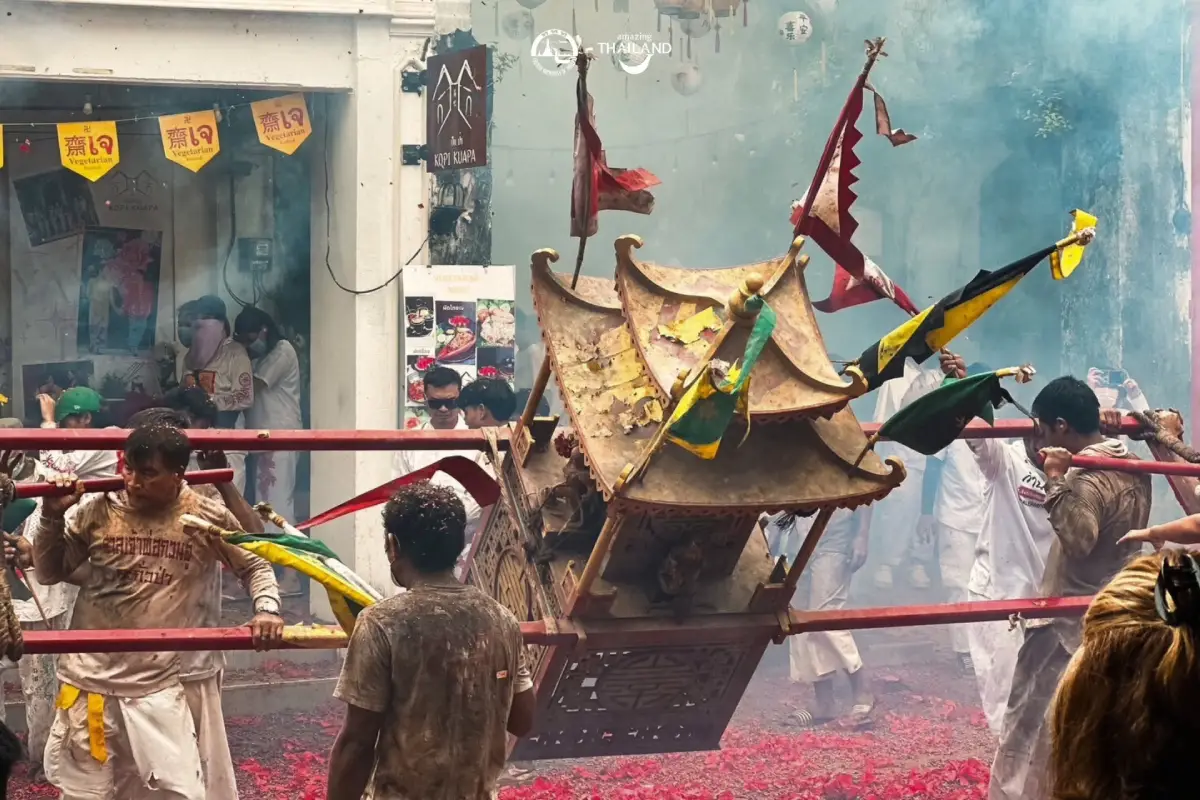
The most visually powerful event is Iu-Keng, or the deity procession around town. In Takua Pa, the procession through the old town is one of the strongest images of the festival. Shrine banners, deity name boards, palanquins, Chinese parasols, drums, spirit mediums, shrine attendants, and white-clad devotees move through the streets. Local residents set up offering tables in front of their homes with tea, fruit, incense, and firecrackers to welcome the deities. The procession is believed to cleanse the town and bring blessings to the community.
Spirit mediums play an important role in the festival. A medium is believed to become a vessel for a deity, receiving misfortune on behalf of devotees and performing ritual acts to protect the community. During processions, mediums may demonstrate spiritual power through the use of sharp objects or weapons according to local belief. These acts should be understood as ritual expressions of faith, not as entertainment. Visitors should watch from a safe distance and respect the sacred nature of the ceremony.
Fire-walking is another major ritual in some shrines. The fire is treated as sacred and purifying. Selected participants or spirit mediums pass over the fire according to ritual order, symbolizing the burning away of impurity and misfortune. Visitors should remain behind designated safety areas and follow instructions from shrine staff.
The closing ceremony, known as sending off the gods, marks the end of the vegetarian period. Some shrines send celestial deities at the Go Teng pole during the day, while the Nine Emperor Gods are sent back at night. In some communities, the final sending ceremony is connected with the sea. After the procession leaves the shrine, lights are extinguished, the pole is lowered, divine troops are called back, and the shrine returns to normal operation. This completes the ritual cycle of the year.
The shrine kitchen is central to the Phang Nga festival. Shrines prepare large amounts of vegetarian food for registered devotees and visitors. Families who wish to receive shrine food may register the number of household members and the number of days they will observe the festival so that the kitchen can prepare enough meals. Many people bring their own food containers or tiffin carriers to receive food from the shrine. Common dishes include stir-fried vegetables, vegetarian curries, clear soups, tofu dishes, noodles, and local dishes adapted into vegetarian form.
Cleaning kitchen equipment is an important part of preparation. Pots, pans, knives, chopping boards, bowls, spoons, and cooking utensils are washed until free of meat smell. Some families use a separate set of utensils only for vegetarian food during the festival. This practice shows that the festival changes not only what people eat but also the daily rhythm of the household.
The festival also creates strong community cooperation. Shrine committees, kitchen volunteers, palanquin bearers, firecracker handlers, procession staff, donors, cooks, cleaners, and local residents all support the event. Wealthy and poor families join under the same white clothing, worship in the same shrine, and share the same vegetarian food. This equality and cooperation are part of the festival’s lasting strength.
In Phang Nga, key festival centers include Guan Yu Shrine or the southern shrine house in Takua Pa Old Town, the northern shrine house, Guan Yin shrines, Mazu Shrine in Mueang Phang Nga, and community shrines in Khuk Khak, Bang Niang, Thai Mueang, and other districts. Each shrine may have its own ritual sequence, procession day, fire-walking ceremony, bridge-crossing ceremony, or sending-off schedule. Travelers should check local announcements close to the festival dates.
Getting There to the Takua Pa festival area is convenient by private car, rental car, local transport, or bus to Takua Pa District. The old town area around Udom Thara Road and Sri Takua Pa Road is the best reference point for Guan Yu Shrine and the procession route. Visitors staying in Khao Lak or Bang Niang can also check festival activities at shrines in Khuk Khak and nearby communities. For Mueang Phang Nga, Mazu Shrine is a major reference point.
The Phang Nga Vegetarian Festival is therefore not only a food festival. It is a living expression of faith, Chinese heritage, local history, spiritual discipline, and community unity. It preserves the identity of Thai-Chinese communities on the Andaman coast and allows visitors to see how ritual, food, sound, movement, and devotion continue to shape local life today.
| Festival Name | Phang Nga Vegetarian Festival |
| Alternative Names | Kin Phak, Vegetarian Festival Phang Nga, Kiu Ong Je, Kiu Ong Tai Te Festival, Takua Pa Vegetarian Festival |
| 2026 Festival Dates | 10 – 18 October 2026, for 9 days and 9 nights, from the 1st to the 9th day of the 9th Chinese lunar month |
| Main Areas | Chinese shrines across Phang Nga Province, especially Takua Pa, Thai Mueang, Mueang Phang Nga, Khuk Khak, and communities with active Chinese shrines |
| Key Reference Venues | Guan Yu Shrine / Southern Shrine House in Takua Pa Old Town and Mazu Shrine in Mueang Phang Nga |
| Takua Pa Reference Address | Udom Thara Road, Old Market Area, Takua Pa Subdistrict, Takua Pa District, Phang Nga 82110, Thailand |
| Takua Pa Reference Coordinates | Ku-Chai-Tueng Shrine / Guan Yu Shrine: 8.8265089587, 98.3647240165 |
| Caretaker / Related Bodies | Shrine committees, Takua Pa Municipality, local administrative organizations, and Phang Nga tourism-related agencies |
| Main Contact Number | Takua Pa Municipality, Tel. 0-7642-4524 |
| Admission Fee | No admission ticket; expenses depend on donations, vegetarian food, transport, and personal offerings |
| Main Rituals | Go Teng pole raising, deity invitation, Pang Ia or Pang Kun, daily worship, Khokun, Song Keng chanting, name reading, star worship, Iu-Keng procession, fire-walking, cleansing rituals, and deity sending ceremony |
| Main Areas / Zones | Shrine hall, Go Teng pole, altar area, vegetarian kitchen, registration point for devotees, vegetarian food area, Iu-Keng procession route, fire-walking area, and deity sending area according to each shrine’s tradition |
| Devotee Practices | Abstaining from meat, eggs, animal products, strong-smelling vegetables, alcohol, intoxicants, and impure conduct, while wearing modest or white clothing during the festival |
| Festival Food | Shrine vegetarian meals, vegetarian rice and curry, vegetarian noodles, tofu dishes, vegetable stir-fries, clear soups, vegetarian curries, and local dishes adapted into vegetarian form |
| Phang Nga Identity | Old Chinese shrines in Takua Pa, Iu-Keng processions through historic streets, firecrackers, Go Teng pole ceremonies, shrine kitchens, spirit mediums, and Thai-Chinese community cooperation on the Andaman coast |
| Travel Information | For Takua Pa, travel via Phetkasem Road to Takua Pa District and continue to the old town around Udom Thara Road and Sri Takua Pa Road. For Mueang Phang Nga, use Mazu Shrine as a reference point. |
| Visitor Safety | Watch for firecrackers, smoke, palanquin routes, spirit mediums, and crowded ritual areas. Stand in safe zones and follow shrine committee instructions. |
| Nearby Tourist Attractions | 1. Takua Pa Old Town, about 0.2 km 2. Takua Pa Old Town Cultural Street, about 0.2 km 3. Taoming School, about 0.3 km 4. Khun In House, about 0.5 km 5. Wat Senanuch Rangsan, about 0.6 km 6. Former Governor’s Residence Wall, about 1 km 7. Boon Sung Iron Bridge, about 5 km |
| Nearby Restaurants | 1. Seen Cafe at Takua Pa, about 0.3 km, Tel. 091-716-9365 2. KOPI KUAPA, about 0.3 km, Tel. 099-459-5355 3. Trok Cafe Takuapa, about 0.4 km, Tel. 063-063-3598 4. Mama’s Oven, about 0.5 km, Tel. 093-249-9369 5. Lok Un, about 1 km, Tel. 087-895-9604 |
| Nearby Accommodations | 1. Takua Pa Station Hotel, about 4 km, Tel. 098-461-9999 2. Good Morning Hotel at Takua Pa, about 5 km, Tel. 091-664-4151 3. Fondness Hotel, about 5 km, Tel. 098-936-9666 4. Fondness Mountain View, about 5 km, Tel. 084-851-3999 5. Nava Tara Resort Takuapa Phang Nga, about 5 km, Tel. 076-670-757 6. Khum Thong Resort Takua Pa, about 6 km, Tel. 083-509-2989 |
Frequently Asked Questions (FAQ)
Q: What is the Phang Nga Vegetarian Festival?
A: It is a Thai-Chinese vegetarian and purification festival held for 9 days and 9 nights. Participants abstain from meat and impure conduct, worship Chinese deities, join shrine rituals, and seek blessings and protection.
Q: When is the Phang Nga Vegetarian Festival in 2026?
A: In 2026, it will be held from 10 to 18 October, corresponding to the 1st to the 9th day of the 9th Chinese lunar month.
Q: Where is the festival most prominent in Phang Nga?
A: Takua Pa is one of the most prominent areas, especially Guan Yu Shrine, the southern shrine house, the northern shrine house, and Takua Pa Old Town. Mueang Phang Nga, Thai Mueang, and Khuk Khak also have important shrine activities.
Q: What does the Go Teng pole mean?
A: The Go Teng pole marks the official start of the festival. Nine lamps are raised on the pole to symbolize the invitation of the Nine Emperor Gods to preside over the ceremony.
Q: What should devotees avoid during the festival?
A: Devotees avoid meat, eggs, animal products, strong-smelling vegetables, alcohol, intoxicants, and impure conduct while maintaining discipline in body, speech, and mind.
Q: What is the Iu-Keng procession?
A: Iu-Keng is the deity procession around town. Palanquins, banners, shrine attendants, spirit mediums, and devotees move through the streets while local residents set up offering tables and welcome the deities with firecrackers.
Q: What should visitors be careful about?
A: Visitors should be careful around firecrackers, smoke, palanquins, spirit mediums, and crowded ritual areas. They should stand in safe zones and follow shrine committee instructions.
Q: How is Phang Nga’s festival different from a general vegetarian food event?
A: Phang Nga’s festival is a full ritual tradition with old Chinese shrines, Go Teng pole ceremonies, daily chanting, Iu-Keng processions, fire-walking, spirit mediums, shrine kitchens, and strong Thai-Chinese community participation.
 Category: ●Art, Culture and Heritage
 Group: ●Art, Craft Centres, Tradition
Last Update : 2 WeekAgo
 Last Update : 2 WeekAgo

 Historical Sites and Monuments(2)
 Landmarks and Memorials(6)
Art, Craft Centres, Tradition(3)
Landmarks and Memorials(6)
Art, Craft Centres, Tradition(3)
 Places of Worship
 Temple(18)
 Other Sacred Sites(8)
 Suburban Living
 Village, Community(3)
 Nature and Wildlife
 National Parks and Marine Reserves(12)
 Mountain (Doi)(8)
 Waterfalls(21)
 Hot Springs(2)
 Caves(12)
 River, Canal(4)
 Bays and Beaches(28)
 Islands(11)
 Other natural attractions(7)
 Entertainment and Agricultural
 Animal camps and shows(2)
 Farms, Parks and Ecotourism(2)
 Outdoor and Adventure Activities(3)
 Travel Articles, Recipes
 Southern Food Menu, Southern Food Recipes(1)


