
lovethailand home >South Travel Attractions >Pattani Travel Attractions >Muang Pattani >Ka Mi Yo > Hae Nok Pattani
TL;DR: Hae Nok Pattani, open No fixed annual date; held occasionally according to community or organizer, hours No permanent schedule; check the event announcement before traveling.
Hae Nok Pattani
Open Days: No fixed annual date; held occasionally according to community or organizer schedules
Opening Hours: No permanent schedule; check the event announcement before traveling
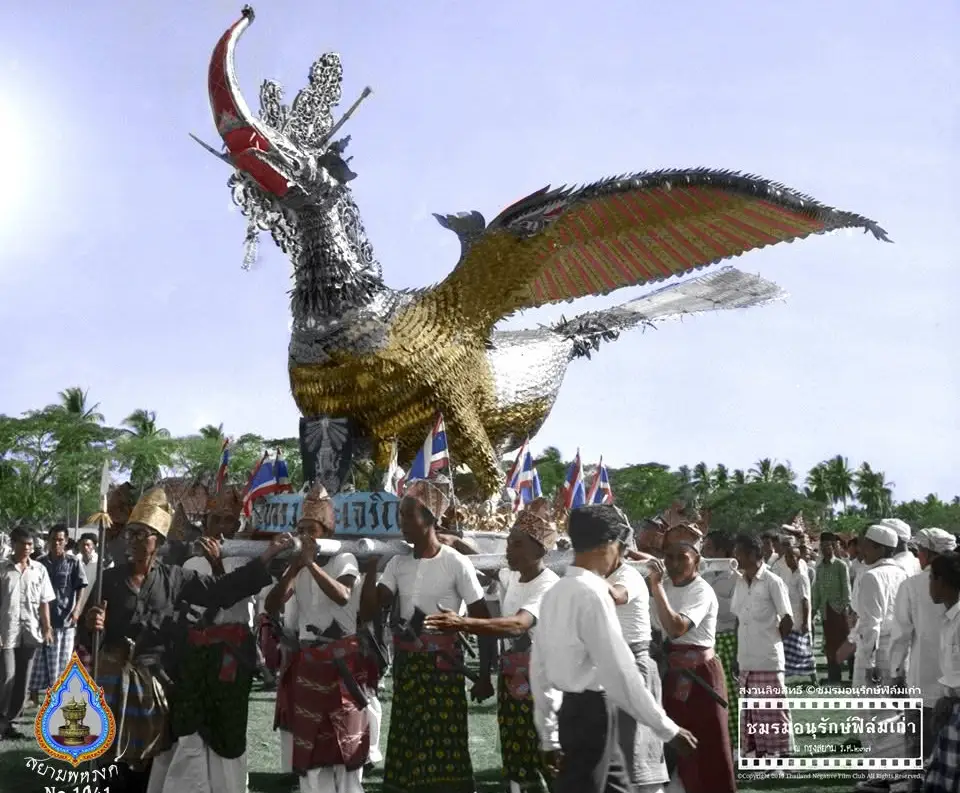
Hae Nok Pattani, or the Bird Parade tradition, is an old local tradition of Thailand’s southern border provinces, especially Pattani, Yala, and Narathiwat. It is a Malay-Thai community tradition that has been passed down for generations. Unlike an annual festival with fixed dates, Hae Nok is held occasionally for specific purposes: celebration, welcoming honored guests, showing respect to important elders, expressing loyalty on formal occasions, entering competitions, or joining community ceremonies such as male circumcision ceremonies known locally as Maso Yawi.
The heart of Hae Nok is the large, beautifully decorated bird effigy carried in procession. The bird is made with vivid colours, detailed decorative patterns, a carrying frame, and carefully arranged components. A complete procession may include traditional music, a bunga sireh or ceremonial offering procession, bird guardians dressed like warriors, the bird-carrying group, kris bearers, spear bearers, and traditional martial performances such as silat, kris dance, and spear dance. This makes Hae Nok a living stage for many forms of local art: wood carving, paper craft, flower arrangement, ceremonial tray design, music, costume, movement, and community coordination.
The importance of Hae Nok should not be understood only through the visual beauty of the bird or the excitement of the parade. The tradition reflects the cultural world of Pattani in a deeper way. Pattani has long been shaped by Langkasuka, Malay, Indonesian, Malaysian, Indian, and Islamic cultural influences. Within the Bird Parade, visitors can see local imagination, the idea of celestial birds, mythical animal forms, Malay craftsmanship, and the communal life of southern border communities woven together.
Several legends explain the origin of the Bird Parade. One version begins in Java, where a ruler had a beloved youngest princess. The ruler and his court searched for beautiful entertainments to please her, including the making of a decorated bird figure that was paraded around the royal hall. The princess was delighted, and the ruler ordered that a bird parade be held regularly. This version presents Hae Nok as a tradition of beauty, joy, and formal honour.
Another version tells of a ruler whose youngest son wanted to see a miraculous bird described by fishermen. The fishermen had seen a strange bird rise from the sea. It had large red eyes, a trunk, tusks, and fangs, yet when it flew into the air it became more beautiful than any ordinary bird. The ruler then ordered skilled craftsmen to create bird figures based on different descriptions of the miraculous creature. The result was 4 distinct bird forms that became important in the southern Bird Parade tradition.
The 4 important bird forms are Nok Kamo Suro or Nok Khae Suro, also associated with the celestial karavika bird and sometimes locally called Nok Thun Phlu; Nok Garuda or the Garuda bird; Nok Bue Khao Mat or the Golden Peacock; and Nok Bu-rong or Bu-rong Si-ngo, also known as the lion-bird. Each form carries a different meaning and visual character, from refined beauty and celestial status to strength, grandeur, and awe.
Nok Kamo Suro is one of the most elegant forms in the tradition. It represents the imagination of a celestial bird, often with a high crest, decorative motifs, lively eyes, and small tusks projecting from the beak. It gives the parade a sense of dignity and high status. Nok Garuda is also part of the traditional set, but beliefs about its powerful or dangerous nature have made it less commonly made or paraded in modern times.
Nok Bue Khao Mat, the Golden Peacock, represents beauty, refined decoration, and careful craftsmanship. Its crest, colours, and feather-like ornamentation help soften the procession and add visual richness. Nok Bu-rong Si-ngo, the lion-bird, is one of the most important forms still associated with Pattani today. It combines bird and lion imagery, giving it both mystery and power. In many contemporary discussions, the Bird Parade is often associated with Bu-rong Si-ngo because this form remains visible in some community events and cultural demonstrations.
Making a parade bird requires skill, time, and cooperation. Traditionally, the head may be carved from strong but workable hardwood such as takhian or kayi wood. The body is often constructed from bamboo, fitted with a carrying beam, covered with base paper, and decorated with coloured paper cut into feather-like forms. Green and gold are commonly used, with other colours added for contrast. A finished bird can be large enough to require several carriers and may be used in a procession where a child in a circumcision ceremony or an honored person sits on the bird according to the nature of the event.
In older practice, some communities performed a head-attaching ceremony before assembling the bird. The ritual items could include a ceremonial cloth canopy, sticky rice, local sweets, yellow-dyed rice, candles, gold, silver, flour, perfume, incense, teacher-honouring money, and young coconut leaves. These items were placed before the bird head, and the ritual specialist lit candles, burned incense, and recited inherited formulas. This shows that bird-making was connected not only with craft but also with teachers, lineage, and respect for transmitted knowledge.
The procession begins with traditional music. A pi chawa, a pair of drums, and a large gong may lead the parade, creating rhythm and atmosphere. The music also supports silat, kris dance, and spear dance. After the musicians comes the bunga sireh or ceremonial tray procession, usually carried by carefully selected women wearing colourful local clothing. This section adds grace, beauty, and ceremonial dignity to the parade.
The bird guardians follow. They are dressed like warriors and carry kris weapons. They are often chosen from people skilled in silat, kris dance, or spear dance. Their role gives the parade a sense of authority and balance. The bird itself is then carried by a team, with the number of carriers depending on the size and weight of the bird. Behind the bird may be kris and spear groups dressed in ancient warrior style, reinforcing the sense of unity, discipline, and communal pride.
Historically, Hae Nok appeared in several important occasions. It was used in circumcision ceremonies within ruling families, in royal reception contexts, during important royal visits to Pattani, in provincial celebrations, and in public cultural events. These occasions show that the Bird Parade was not only a village entertainment. It could function as a ceremonial expression of honour, loyalty, hospitality, and collective identity.
Today, Hae Nok is not held as frequently as in the past, but it continues to appear on some important occasions. Bu-rong Si-ngo in particular is still used in some circumcision ceremonies, village celebrations, cultural events, competitions, and demonstrations. The period around April and May is sometimes associated with circumcision ceremonies, except during the fasting month, but actual dates depend on the host, the community, and the specific event. Travelers should always check current announcements before planning a trip.
The value of Hae Nok lies in its ability to preserve many local arts at once. Bird-makers preserve structure, proportion, colour, carving, and decoration. Musicians preserve the sound of pi chawa, drums, and gong. Silat performers preserve martial movement and discipline. Women in the bunga sireh procession preserve ceremonial grace. Organizers preserve parade order and community cooperation. The tradition therefore survives only when many people work together.
Visitors who want to see Hae Nok should understand that it has no permanent venue. It may be held in a village, at a cultural event, during a community ceremony, or at a public celebration. Before traveling, check announcements from the Pattani Provincial Cultural Office, local authorities, or the host community. During the procession, do not obstruct the route, do not touch the bird or ritual objects, do not disturb performers, and ask permission before taking close-up photos of people.
In summary, Hae Nok Pattani is a southern border tradition that brings joy, beauty, respect, creativity, and unity into a single procession. Its 4 bird forms, music, bunga sireh procession, warrior guardians, kris and spear groups, silat, craftsmanship, and teacher-based craft knowledge make it one of Pattani’s most distinctive cultural expressions. For travelers who want to understand Pattani beyond ordinary sightseeing, Hae Nok offers a deep view into Malay-southern Thai imagination, artistry, and community life.
| Name | Hae Nok / Bird Parade / Hae Nok Bu-rong Si-ngo |
| Practice Area | Southern border provinces of Thailand, especially Pattani, Yala, and Narathiwat |
| Type | Local tradition, folk performance, intangible cultural heritage, and ceremonial parade |
| Event Period | Held occasionally, not on a fixed annual date. It may be arranged for guest receptions, community ceremonies, circumcision ceremonies, competitions, or cultural events |
| Viewing Hours | Depends on each event schedule. Check announcements from organizers or local authorities before traveling |
| Admission Fee | Depends on the event type. Many community or cultural demonstration events are viewed according to the venue arrangements |
| Significance | A Malay-southern Thai tradition used for celebration, respect, guest reception, loyalty, and the preservation of local arts |
| Key Features | Large decorated bird effigies, pi chawa music, drums, gong, bunga sireh procession, warrior-style guardians, kris and spear groups, and silat performance |
| Main Bird Forms | 1. Nok Kamo Suro / Nok Khae Suro / Nok Kaka Sura 2. Nok Garuda 3. Nok Bue Khao Mat / Golden Peacock 4. Nok Bu-rong / Bu-rong Si-ngo / Lion-Bird |
| Procession Elements | Traditional music, bunga sireh procession, bird guardians, bird carriers, kris bearers, spear bearers, silat, kris dance, and spear dance |
| Materials | Bird heads may be carved from strong wood such as takhian or kayi; the body uses bamboo frame, carrying beams, base paper, and coloured decorative paper |
| Information Contact | Pattani Provincial Cultural Office, local authorities, and community event organizers |
| Main Contact Number | Pattani Provincial Cultural Office, Tel. 073-460064 / 073-323195-7 |
| Visitor Etiquette | Do not block the procession, do not touch the bird or ritual objects, do not disturb performers, ask permission before close-up photography, and respect the host community |
| Cultural Places To Combine In Pattani | 1. Chao Mae Lim Ko Niao Shrine, Mueang Pattani 2. Pattani Central Mosque, Mueang Pattani 3. Krue Se Mosque, Mueang Pattani 4. Barahom Community, Mueang Pattani 5. Yaring Old Palace, Yaring District 6. Bang Pu Tourism Community, Yaring District |
| Restaurants In Pattani City Route | 1. Areenee Phochana, Tel. 073-313641 2. Hometown Pattani, Tel. 081-3253833 3. Roo Noodles & Coffee Rusamilae, Tel. 085-5176010 4. De Krue Se Boat Noodles, Tel. 064-9390244 5. Godown Tea Shop Rusamilae Branch, Tel. 062-3042273 |
| Accommodations In Pattani City Route | 1. Pattanipirom Boutique Hotel, Tel. 081-6983877 2. Southern View Hotel Pattani, Tel. 073-450570-72 3. C.S. Pattani Hotel, Tel. 073-335093-4, 073-336090 4. Park View Resort Pattani, Tel. 073-335100 5. BM Pattani Apartment 2, Tel. 091-2029009 |
Frequently Asked Questions (FAQ)
Q: What is Hae Nok Pattani?
A: Hae Nok Pattani is a southern border Bird Parade tradition featuring large decorated bird effigies, music, ceremonial offerings, warrior-style escorts, and traditional performance.
Q: Is Hae Nok a religious ceremony?
A: It is a community tradition rather than a direct religious ceremony. It may be held with community ceremonies such as circumcision, but it is not a fixed religious festival.
Q: When is Hae Nok held?
A: It has no fixed annual date. It is held occasionally for guest receptions, community celebrations, circumcision ceremonies, competitions, and cultural events.
Q: What are the 4 main birds in the tradition?
A: The 4 main forms are Nok Kamo Suro or Nok Khae Suro, Nok Garuda, Nok Bue Khao Mat or Golden Peacock, and Nok Bu-rong Si-ngo or the lion-bird.
Q: What does the procession include?
A: It may include pi chawa music, drums, gong, bunga sireh, bird guardians, bird carriers, kris bearers, spear bearers, silat, kris dance, and spear dance.
Q: What is Bu-rong Si-ngo?
A: Bu-rong Si-ngo, or the lion-bird, is one of the key bird forms in the tradition. It combines bird and lion imagery and remains strongly associated with Pattani’s Bird Parade heritage.
Q: How can visitors find a Hae Nok event?
A: Visitors should check announcements from the Pattani Provincial Cultural Office, local authorities, or the host community because the tradition has no permanent venue or fixed schedule.
Q: How should visitors behave during the procession?
A: Visitors should avoid blocking the route, avoid touching the bird or ritual objects, respect performers and the host community, and ask permission before taking close-up photos of people.
 Category: ●Art, Culture and Heritage
 Group: ●Art, Craft Centres, Tradition
Last Update : 3 WeekAgo
 Last Update : 3 WeekAgo
 Historical Sites and Monuments(3)
 Landmarks and Memorials(7)
 Royal Palace(2)
Art, Craft Centres, Tradition(7)
Royal Palace(2)
Art, Craft Centres, Tradition(7)
 Historic Homes and Cities(1)
 Educational Places
 Museum for Study(1)
 Training Center(1)
 Places of Worship
 Temple(13)
 Mosque(5)
 Other Sacred Sites(4)
 Research and Development
 Royal Project(2)
 Suburban Living
 Village, Community(5)
 Local Market(2)
 Nature and Wildlife
 National Parks and Marine Reserves(2)
 Mountain (Doi)(3)
 Waterfalls(3)
 River, Canal(2)
 Bays and Beaches(13)
 Islands(2)
 Other natural attractions(1)
 Entertainment and Agricultural
 Farms, Parks and Ecotourism(1)
 Travel Articles, Recipes
 Travel Review, Food Review(1)
 Southern Food Menu, Southern Food Recipes(3)


