
lovethailand home >Northeastern Travel Attractions >Nakhon Ratchasima Travel Attractions > Northeastern Folk Songs
TL;DR: Northeastern Folk Songs, open Isan folk songs are living cultural heritage and performing arts that can be, hours There are no single opening hours for Isan folk songs as a cultural topic.
Northeastern Folk Songs
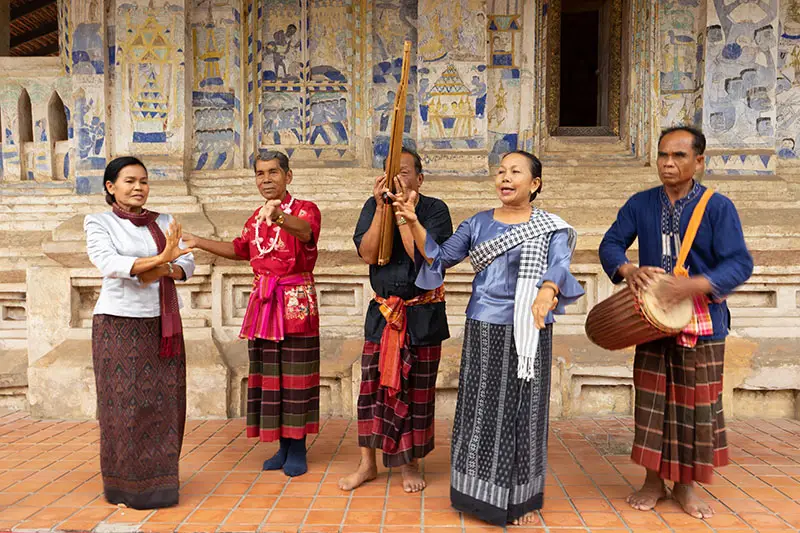
Open Days: Isan folk songs are living cultural heritage and performing arts that can be studied, experienced, and performed throughout the year. Actual performance dates depend on temple fairs, merit-making events, local festivals, cultural stages, educational institutions, or event organizers in each area.
Opening Hours: There are no single opening hours for Isan folk songs as a cultural topic. Performances of mor lam, serng, ja-riang, kantruem, and Korat songs follow the schedule of each event, venue, community, or organizer.
Isan folk songs are oral literature and performing arts of Northeastern Thailand. They reflect local languages, ways of life, beliefs, temple festivals, humor, love, community wisdom, and social memory. They can be divided into three major cultural groups: the Thai-Lao group, represented by mor lam and serng; the Khmer-Suay or Kuy group, represented by ja-riang and kantruem; and the Thai Korat group, represented by Korat songs. These traditions are still performed in merit-making events, temple fairs, local festivals, auspicious ceremonies, vow-fulfillment performances, cultural stages, schools, universities, and contemporary media.
Isan folk songs are traditional vocal and performing arts rooted in the everyday life of Northeastern Thailand. They are not only forms of entertainment, but also oral literature, community communication, local education, and cultural memory. Through melody, language, rhythm, dance, improvisation, and interaction with audiences, Isan folk songs express the thoughts, beliefs, humor, values, emotions, and experiences of local people. They are deeply connected with temple fairs, merit-making events, farming cycles, community gatherings, family ceremonies, and seasonal festivals.
Northeastern Thailand is a large region with several overlapping cultural communities. As a result, Isan folk songs are not a single uniform genre. They can be divided into three major cultural groups: folk songs of the Thai-Lao cultural group, folk songs of the Khmer-Suay or Kuy cultural group, and folk songs of the Thai Korat cultural group. This division helps explain why Isan music has so many sounds, languages, rhythms, and performance styles. Isan is not one simple cultural block; it is a region of many voices.
The Thai-Lao cultural group is found widely across provinces such as Nong Khai, Udon Thani, Loei, Sakon Nakhon, Nakhon Phanom, Kalasin, Maha Sarakham, Roi Et, Khon Kaen, Chaiyaphum, Mukdahan, Yasothon, Ubon Ratchathani, Buri Ram, and parts of Si Sa Ket. The main local language of this group is Isan, which is closely related to Lao in the Mekong cultural sphere. The most important folk-song forms of this group are mor lam and serng. Both forms play important roles in entertainment, ritual, storytelling, courtship, moral teaching, and public performance.
Mor lam is one of the most popular and influential folk performing arts of Northeastern Thailand. The word “lam” means melodic recitation or singing, while “mor” refers to a skilled person or specialist. A mor lam performer is therefore a specialist in melodic storytelling. A good performer needs vocal skill, memory, local knowledge, poetic language, humor, moral understanding, and the ability to respond to the audience. Mor lam is not simply singing. It is a living art of voice, words, wisdom, and performance.
Mor lam melodies are known locally as “lai.” Each lai gives the performance a different emotional and rhythmic identity. Well-known melodic styles include lai thang san, lai thang yao, lai lam phloen, and lai lam toei. Lai thang san is compact and energetic. Lai thang yao is longer and more suitable for extended storytelling or emotional expression. Lai lam phloen is lively and accessible. Lai lam toei has a sweet and expressive quality. These melodic frameworks allow mor lam to adapt to many performance settings, from intimate community gatherings to large public stages.
Mor lam developed from local oral performance into professional troupes. Performers train with teachers, master melodies, memorize stories, learn improvisation, and perform at events. Some forms focus on storytelling, such as narrative lam. Some focus on male-female poetic exchanges, such as mor lam klon. Some have grown into large theatrical or concert-like productions, such as mor lam mu and mor lam sing. This capacity for adaptation is one reason mor lam remains alive in contemporary Isan society.
The khaen is the most iconic instrument associated with mor lam. Its sound immediately evokes Isan identity. The khaen does not merely accompany the singer; it interacts with the voice, supports the melody, shapes the emotional atmosphere, and guides the flow of the performance. A skilled khaen player can make the song feel joyful, sorrowful, tender, playful, or powerful. In many contexts, the sound of the khaen is almost inseparable from the sound of Isan itself.
Serng, or lam serng, is another important folk-song and dance form of the Thai-Lao cultural group. The word “serng” refers to lively dancing or rhythmic movement. Serng is closely connected with processions, merit-making events, temple activities, and community rituals. It is usually performed by groups who sing, dance, and move together in a festive manner. Common forms include serng bang fai, serng tao nang maeo, and serng tao nang dong. These performances combine rhythm, movement, humor, community participation, and ritual meaning.
Serng bang fai is linked with the Rocket Festival, an important Isan tradition associated with rain and agricultural fertility. Its movements and rhythms are energetic, joyful, and communal. Serng tao nang maeo is connected with rain-seeking rituals in agricultural communities during periods of drought. Serng tao nang dong is another folk performance associated with local processions and merit-making activities. In these forms, serng is not only entertainment; it is part of the community’s relationship with nature, rain, agriculture, and collective belief.
The Khmer-Suay or Kuy cultural group is prominent in Surin, Si Sa Ket, and parts of Buri Ram. These communities have their own languages and cultural identities, including Thai-Khmer dialects and Kuy or Suay language. Their important folk-song form is ja-riang, a local vocal tradition that means singing or chanting. Ja-riang reflects the soundscape of lower Isan. Its language, melody, rhythm, and performance context differ from Thai-Lao mor lam, while still serving similar community functions in festivals, rituals, celebrations, and social gatherings.
Ja-riang appears in two major forms. One form is ja-riang performed with a kantruem ensemble. The ensemble may include instruments such as pi-or, pi-chalai, kantruem drum, small cymbals, large cymbals, and wooden clappers. In some modern groups, saw-u and saw-duang may also be added. The lyrics are usually chosen to match the nature of the event, such as merit-making, auspicious ceremonies, festivals, or audience requests. This makes the performance flexible and closely connected with the mood of the occasion.
The second form places ja-riang as the main performance. During festivals, villagers with artistic skill may gather to sing inherited songs, take turns performing, and dance together. Examples include ja-riang trut and ja-riang nor kaeo, which are known for male-female exchange. These performances reveal wit, humor, poetic language, and the performers’ ability to adapt inherited forms to the present moment. Like mor lam, ja-riang depends strongly on memory, local language, and audience interaction.
Kantruem is a significant musical and performance tradition of lower Isan, especially in Thai-Khmer cultural areas. Its rhythm, instruments, and vocal style create a distinctive musical identity. Kantruem supports ja-riang, dance, ritual, and local celebration. The sound of reed instruments, drums, cymbals, and clappers gives the performance its lively character, while the lyrics preserve local language, beliefs, and stories. In Surin, Si Sa Ket, and Buri Ram, kantruem remains one of the clearest expressions of lower Isan culture.
The Thai Korat cultural group is centered in Nakhon Ratchasima and parts of Buri Ram. Its major folk-song form is phleng Korat, or Korat song. Korat songs are performed in the Thai Korat language, a distinctive local speech with its own tone, vocabulary, and cultural identity. The performance usually takes the form of male-female verbal exchange. Performers need sharp wit, memory, poetic skill, timing, and confidence. Today, Korat songs have developed into professional troupes that perform at merit-making events, auspicious ceremonies, festivals, and vow-fulfillment rituals dedicated to Thao Suranari.
Korat songs often include courtship, playful teasing, moral reflection, local stories, social commentary, and ceremonial themes. The poetic forms include different patterns such as phleng khu song and phleng khu si. One memorable feature is the rhythmic clapping before ending a song phrase, followed by the vocal expression “chai ya.” This gives Korat songs a recognizable cadence and separates them clearly from mor lam and ja-riang. The use of Thai Korat language also gives the performance a strong regional identity.
As a whole, Isan folk songs are a form of oral literature. They have been passed down through memory, listening, apprenticeship, public performance, and participation rather than through written authorship alone. Many songs do not have a single known composer. Their value lies in collective memory and local use. They record ways of thinking, beliefs, humor, moral lessons, emotions, migration, farming life, love, hardship, hope, and social change. This is why Isan folk songs are not only music; they are living records of community life.
Local language is at the heart of these traditions. Isan, Thai-Khmer dialects, Kuy, and Thai Korat give each performance its own flavor. The words often rhyme, play with sound, use metaphor, and contain local idioms that carry deeper meaning for people from the community. Audiences do not only understand the literal meaning of the lyrics. They also hear accent, emotion, social context, wit, and identity. In this sense, folk songs help keep local languages alive.
The content of Isan folk songs is highly varied. They can speak about love, courtship, humor, village life, Buddhist teachings, folktales, gratitude, farming, drought, rain, migration, nostalgia, social issues, and national events. As society changes, folk songs can incorporate new themes such as city work, education, travel, technology, and modern relationships. This flexibility explains why they continue to survive. They are traditional, but they are not frozen in the past.
Folk songs play an important role in Isan merit-making culture. Temple fairs and community events are not only religious ceremonies; they are also social spaces where people gather, eat, dance, listen, and celebrate. Mor lam, serng, kantruem, ja-riang, and Korat songs help create atmosphere and participation. Some forms are used in processions to collect offerings. Some appear after religious rituals as entertainment. Some are performed for vows, blessings, or local celebrations. Music and merit-making therefore remain closely linked in Isan life.
Isan folk songs also function as informal education. Through songs, people learn language, moral values, local history, social expectations, humor, and cultural memory. Young people can learn proverbs, poetic phrases, stories, and respect for teachers through performance traditions. Folk songs act as community classrooms, where knowledge is carried by voice, rhythm, gesture, and repeated participation rather than textbooks alone.
In contemporary society, Isan folk songs continue to adapt. Mor lam now appears on large stages with sound systems, lighting, choreography, costumes, and concert-style presentation. Ja-riang and kantruem still remain important in lower Isan cultural areas and appear at heritage events. Korat songs continue to be associated with Nakhon Ratchasima, local ceremonies, and vow-fulfillment performances. Schools, universities, cultural centers, and communities also play a role in documentation, education, and transmission.
Media change has allowed Isan folk songs to travel beyond their original communities. Performances can now be seen on television, radio, online video, live streaming, social media, and short-form video platforms. This allows Isan people living outside the region, Thai audiences nationwide, and international viewers to access these arts more easily. Even so, live performance remains central. The energy of folk songs comes from interaction between performers and audiences, improvisation, humor, and the atmosphere of a real event.
Travelers who want to experience Isan folk songs can find them in temple fairs, provincial festivals, cultural events, local stages, university cultural centers, and community celebrations. Mor lam is often found in temple fairs, outdoor festivals, and large event stages. Kantruem and ja-riang are best associated with lower Isan provinces such as Surin, Si Sa Ket, and Buri Ram. Korat songs are most closely connected with Nakhon Ratchasima, especially in local ceremonies and events linked with Thao Suranari.
The Art and Culture Center of Khon Kaen University is a useful reference point for learning about Isan culture in a broader sense. It functions as a center of information, learning, and cultural activities related to Northeastern Thailand. It also connects with databases on mor lam and Isan performances. Such institutions help visitors and learners understand folk songs not only as entertainment, but as part of language, history, performing arts, community knowledge, and regional identity.
For international travelers, Isan folk songs provide an important gateway into Thailand beyond major tourist cities. Mor lam reveals the power of Isan storytelling and the khaen. Ja-riang and kantruem reveal the sound of lower Isan and Thai-Khmer cultural identity. Korat songs reveal the distinctiveness of Nakhon Ratchasima and Thai Korat speech. Watching these performances helps travelers understand people, language, humor, ritual, and community life in ways that sightseeing alone cannot provide.
These traditions also have social value because they bring generations together. Teachers, singers, musicians, dancers, audiences, event organizers, and communities all participate in keeping the arts alive. Older generations transmit lyrics, melodies, gestures, and performance etiquette. Younger generations adjust costumes, stage design, rhythm, media, and presentation. This continuity makes Isan folk songs living heritage rather than static relics.
From a linguistic point of view, Isan folk songs preserve many local words, idioms, metaphors, and poetic expressions. Phaya, witty exchanges, courtship lines, moral phrases, and improvised verses elevate local speech into art. A skilled performer can make the audience laugh, think, feel moved, or respond instantly through only a few lines. This is the power of oral literature: it lives in the voice and the moment of performance.
From a musical point of view, Isan folk songs combine voice, instruments, rhythm, and movement into one integrated performance system. The khaen, phin, pong lang, drums, cymbals, wooden clappers, pi-or, pi-chalai, kantruem drum, saw-u, and saw-duang all contribute different colors. Some instruments carry the main melody, some create rhythm, some support ritual atmosphere, and some energize the audience. The music cannot be separated from singing, dance, and social context.
In cultural tourism, Isan folk songs deepen the travel experience. A visitor to Khon Kaen can connect with mor lam, khaen, and Isan cultural learning. A visitor to Surin can encounter kantruem, ja-riang, elephant culture, silk, and lower Isan identity. A visitor to Nakhon Ratchasima can discover Korat songs and Thai Korat speech. A journey along the Mekong may include mor lam and local performance during festivals. Folk songs give Isan travel a voice, a rhythm, and a living human dimension.
In summary, Isan folk songs are cultural heritage that brings together language, music, performance, oral literature, festivals, and community life. They include mor lam and serng of the Thai-Lao cultural group, ja-riang and kantruem of the Khmer-Suay or Kuy cultural group, and Korat songs of the Thai Korat cultural group. Each form reflects local creativity and continues to adapt in contemporary society. These songs are the voice of Isan: joyful, witty, spiritual, emotional, memorable, and deeply connected with the wisdom of local communities.
| Topic Name | Isan Folk Songs / Folk Songs Of Northeastern Thailand |
| Category | Folk Culture, Oral Literature, Folk Music, And Performing Arts Of Northeastern Thailand |
| Main Area | Northeastern Thailand, covering Thai-Lao, Khmer-Suay Or Kuy, And Thai Korat cultural communities |
| Reference Learning Site | Art And Culture Center, Khon Kaen University, 123 Mittraphap Road, Nai Mueang Subdistrict, Mueang Khon Kaen District, Khon Kaen 40002, Thailand |
| Reference Coordinates | 16.445083252031715, 102.81458528576835 |
| Current Status | Still transmitted, studied, and performed in merit-making events, temple fairs, auspicious ceremonies, vow-fulfillment performances, cultural stages, educational institutions, and contemporary media |
| Open Days | Available for study and performance year-round according to the schedule of each cultural center, festival, community event, or performance organizer |
| Opening Hours | No single opening hours for Isan folk songs as a cultural topic. Visiting learning sites or watching performances depends on each venue and event schedule. |
| Admission Fee | No admission fee for the topic as a whole. Costs depend on the learning site, festival, ticketed event, or performance arrangement. |
| Caretaker / Related Parties | Department Of Cultural Promotion, Ministry Of Culture, Provincial Cultural Offices, educational institutions, cultural centers, communities, folk-song teachers, mor lam troupes, kantruem groups, Korat song troupes, and local performing artist networks |
| Main Contact Number | Art And Culture Center, Khon Kaen University Tel. 043-202-663, 043-332-760 Art Centre, Khon Kaen University Tel. 043-202-308 |
| Main Cultural Groups | 1. Thai-Lao Cultural Group 2. Khmer-Suay Or Kuy Cultural Group 3. Thai Korat Cultural Group |
| Important Folk-Song Forms | Mor Lam, Lam Serng, Serng Bang Fai, Serng Tao Nang Maeo, Serng Tao Nang Dong, Ja-Riang, Kantruem, Ja-Riang Trut, Ja-Riang Nor Kaeo, And Korat Songs |
| Related Instruments | Khaen, Phin, Pong Lang, Drums, Small Cymbals, Large Cymbals, Wooden Clappers, Pi-Or, Pi-Chalai, Kantruem Drum, Saw-U, And Saw-Duang In Some Ensembles |
| Knowledge Zones / Main Areas | Mor lam and khaen zone Serng and folk procession zone Ja-riang and lower Isan kantruem zone Korat song zone Oral literature and phaya zone Folk instrument zone Isan merit-making and festival zone Contemporary performance and festival stage zone |
| Related Activities | Watching mor lam, listening to khaen music, seeing serng in folk processions, experiencing ja-riang and kantruem in lower Isan, watching Korat songs in local ceremonies, learning phaya, studying folk instruments, and joining Isan merit-making festivals |
| Travel Information | From Bangkok, travelers can enter Isan by Mittraphap Road, Northeastern railway lines, or domestic flights to major provinces such as Khon Kaen, Udon Thani, Ubon Ratchathani, Nakhon Phanom, Buri Ram, and Loei. For the Khon Kaen University reference site, access is available directly from Mittraphap Road. |
| Facilities | Learning centers, cultural databases, activity spaces, art and culture halls, outdoor stages in some areas, educational institutions, restaurants, hotels, local markets, urban transport, and festival venues across Isan provinces |
| Nearby Attractions / Learning Sites Near The Khon Kaen Reference Point | 1. Art Centre, Khon Kaen University, about 0 km, Tel. 043-202-308 2. Si Than Lake, Khon Kaen University, about 1 km 3. Faculty Of Fine And Applied Arts, Khon Kaen University, about 1 km, Tel. 043-202-396 4. Natural History Museum, Khon Kaen University, about 2 km 5. Khon Kaen City Pillar Shrine, about 8 km 6. Wat Phra Mahathat Kaen Nakhon / Wat Nong Waeng Royal Temple, about 11 km |
| Nearby Restaurants Near The Khon Kaen Reference Point | 1. The Lao Café KKU, about 1 km, Tel. 064-276-5780 2. Restaurants and cafes around Si Than Lake, about 1 km 3. Restaurants at Modindaeng Market, Khon Kaen University, about 2 km 4. Restaurants in Kang Sadan Area, about 3 km 5. Restaurants along Mittraphap Road near Khon Kaen University, about 3 km 6. Restaurants in Khon Kaen City Center, about 8-11 km |
| Nearby Accommodations Near The Khon Kaen Reference Point | 1. Bayasita@KKU, about 1 km, Tel. 088-062-0132, 081-768-9618 2. Hotels around Khon Kaen University and Kang Sadan Area, about 2-4 km 3. Hotels along Mittraphap Road near Khon Kaen University, about 3-5 km 4. Avani Khon Kaen Hotel & Convention Centre, about 8 km 5. Hotels around Central Khon Kaen, about 8 km 6. Hotels in Khon Kaen City Center, about 8-12 km |
Frequently Asked Questions (FAQ)
Q: How are Isan folk songs categorized?
A: Isan folk songs are commonly divided into three major cultural groups: the Thai-Lao cultural group, the Khmer-Suay or Kuy cultural group, and the Thai Korat cultural group.
Q: What are the main folk-song forms of the Thai-Lao cultural group?
A: The main forms are mor lam and serng. Mor lam focuses on melodic singing, storytelling, Isan language, and khaen music, while serng emphasizes group singing and dancing in processions, merit-making events, and community rituals.
Q: Why is mor lam important to Isan culture?
A: Mor lam reflects the Isan language, phaya poetry, folktales, Buddhist teachings, love, humor, and local life. It functions as entertainment, moral teaching, storytelling, and a gathering point for communities.
Q: What is serng?
A: Serng is a lively folk singing and dancing tradition often performed in processions, merit-making events, and rituals. Well-known forms include serng bang fai, serng tao nang maeo, and serng tao nang dong.
Q: Which areas are associated with ja-riang and kantruem?
A: Ja-riang and kantruem are associated with Khmer-Suay or Kuy cultural communities in lower Isan, especially in Surin, Si Sa Ket, and parts of Buri Ram Province.
Q: How are Korat songs different from mor lam?
A: Korat songs use the Thai Korat language and focus on male-female verbal exchange, wit, poetic forms, rhythmic clapping, and the phrase “chai ya.” Mor lam uses Isan language and is strongly connected with lam melodies and khaen music.
Q: Are Isan folk songs still performed today?
A: Yes. They are still performed and transmitted in merit-making events, temple fairs, auspicious ceremonies, vow-fulfillment performances, festivals, cultural stages, educational institutions, and contemporary media.
Q: Where can foreign travelers experience Isan folk songs?
A: Foreign travelers can experience them at local festivals, temple fairs, cultural centers, educational institutions, and performance stages in Isan provinces such as Khon Kaen, Surin, Nakhon Ratchasima, Ubon Ratchathani, and Mekong riverside provinces.
 Category: ●Travel Articles, Recipes
 Group: ●Travel Review, Food Review
Last Update : 3 MonthAgo
 Last Update : 3 MonthAgo
Recommend

 Art, Culture and Heritage
 Historical Sites and Monuments(20)
 Landmarks and Memorials(5)
 Art, Craft Centres, Tradition(7)
 Museums(6)
 Art Gallery(1)
 Educational Places
 Educational Gardens, Farm(4)
 Places of Worship
 Temple(29)
 Mosque(1)
 Other Sacred Sites(6)
 Research and Development
 Royal Project(3)
 Suburban Living
 Village, Community(6)
 Local Market(4)
 Floating Market(1)
 Nature and Wildlife
 National Parks and Marine Reserves(3)
 Mountain (Doi)(5)
 Dam, Reservoir, Lake(8)
 Waterfalls(9)
 Hot Springs(1)
 Caves(2)
 Flower Field(1)
 River, Canal(8)
 Bays and Beaches(2)
 Other natural attractions(3)
 Entertainment and Agricultural
 Zoos and Aquariums(2)
 Animal camps and shows(1)
 Farms, Parks and Ecotourism(21)
 Waterpark(4)
 Outdoor and Adventure Activities(6)
 Shopping
 Shopping and Night Market(2)
Travel Review, Food Review(6)
Shopping and Night Market(2)
Travel Review, Food Review(6)


